Karnak Temple is one of the most impressive ancient sites in Egypt.
Located on the east bank of the Nile in modern Luxor, Karnak is much more than a single temple. It is a vast religious complex that grew over many centuries.
Pharaohs added pylons, halls, sanctuaries, statues, obelisks, columns, chapels, and courtyards. Each generation changed the site while respecting its importance as a sacred center.
The result is an extraordinary mixture of architecture from different periods of ancient Egyptian history.
For travelers, however, the enormous size of Karnak can also make a visit confusing.
Where should you look?
What do the giant columns represent?
Why are there so many temples?
Who built the Great Hypostyle Hall?
What was the purpose of the obelisks?
And why was Karnak so important to the ancient Egyptians?
This guide will help you understand the history, architecture, religion, and major monuments of Karnak Temple. It will also explain what to look for during your visit and how to plan a trip to Luxor from Hurghada.
Where Is Karnak Temple?
Karnak Temple is located on the east bank of the Nile in Luxor.
Ancient Luxor was known as Thebes, one of the most important cities in ancient Egypt.
Thebes became especially important during the Middle and New Kingdoms. It was closely connected with the worship of Amun, one of the most important gods in the Egyptian religious tradition. UNESCO describes ancient Thebes as the city of Amun and recognizes Karnak and Luxor among its outstanding monumental complexes.
Today, Luxor is one of Egypt’s most important archaeological destinations.
Visitors can explore several major sites in the area, including:
- Karnak Temple
- Luxor Temple
- Valley of the Kings
- Valley of the Queens
- Hatshepsut’s Temple
- Colossi of Memnon
- Tombs and temples across the west bank
Karnak is therefore an important part of a wider Luxor experience.
Karnak Temple Is Actually a Temple Complex
One of the first things visitors should understand is that Karnak is not one simple temple.
It is a huge complex containing several religious areas.
The largest and most famous section is the precinct of Amun-Ra.
There are also areas associated with other deities, including the goddess Mut and the god Montu.
The complex developed gradually.
Different rulers added new structures to the site.
Some buildings were demolished, modified, expanded, or incorporated into later constructions.
This explains why Karnak can look so different from one area to another.
It is almost like walking through several chapters of Egyptian history at the same time.
UNESCO notes that the Karnak site contains numerous temples and structures, including the temple of Amun, the temple of Ra-Horakhty, the temples of Khonsu and Ptah, pylons, obelisks, courtyards, halls, and inner chambers.
When Was Karnak Temple Built?
Karnak was not built in one year or even during one dynasty.
Its history stretches across a very long period.
Archaeological evidence places early activity at Karnak in the Middle Kingdom, while later rulers expanded the complex on a huge scale.
The site continued to change during the New Kingdom and later periods.
This long development is one of the reasons Karnak is so fascinating.
Instead of representing one pharaoh’s vision, it reflects the ambitions of many rulers.
Among the most important pharaohs connected with Karnak are:
- Senusret I
- Hatshepsut
- Thutmose I
- Thutmose III
- Amenhotep II
- Amenhotep III
- Seti I
- Ramesses II
- Ramesses III
- Later rulers of the Late Period
- Ptolemaic rulers
Each contributed to the complex in different ways.
The result is a monumental record of changing Egyptian religion and royal power.
The Religious Importance of Karnak
To understand Karnak, it helps to understand Amun.
Amun became one of the most powerful gods in ancient Egypt.
He was associated with Thebes and later became closely connected with the sun god Ra.
This produced the important deity known as Amun-Ra.
The temple complex became a major center of his worship.
The king had an important role in maintaining the relationship between the gods and Egypt.
Temple rituals were therefore not simply religious ceremonies in the modern sense.
They were connected with kingship, cosmic order, prosperity, and the continued stability of the country.
Karnak was one of the places where these ideas were expressed through architecture.
The Sacred Landscape of Karnak
Ancient Egyptians did not view temples simply as buildings.
A temple was a sacred environment.
Different areas had different levels of access.
Large outer spaces could accommodate processions and ceremonies.
More restricted areas were reserved for priests and sacred rituals.
The innermost sanctuary was among the most sacred areas.
This creates a gradual movement from public space toward divine space.
When walking through Karnak today, you can still notice this progression.
The farther you move into the temple, the more enclosed and restricted the architecture becomes.
The Great Avenue of Sphinxes
One of the most recognizable features associated with Karnak is the avenue of sphinxes.
These statues were connected with ceremonial routes between Karnak and Luxor Temple.
The sphinxes were not merely decorative.
They formed part of the sacred processional landscape.
Many of the statues have the body of a lion combined with a human or ram-related head.
The ram was strongly associated with Amun.
Therefore, the avenue helped express the religious identity of Karnak.
Imagine the ancient procession moving along this route.
Priests, officials, musicians, sacred objects, and royal representatives could take part in ceremonies.
The temple would have been experienced through movement, sound, ritual, and symbolism.
The First Pylon
The First Pylon is one of the most recognizable monumental entrances to Karnak.
A pylon is a massive gateway formed by two large towers.
The central entrance leads into the temple complex.
The First Pylon is impressive because of its enormous scale.
However, it also tells us something important about Karnak.
The temple was constantly changing.
The First Pylon belongs to a later stage of the complex than some of the famous structures found deeper inside.
This means visitors should not assume that the temple was built from the entrance inward according to one original plan.
Instead, later rulers continued expanding the sacred complex.
The Great Court
After passing through the entrance area, visitors reach the Great Court.
This is a large open space surrounded by monumental structures.
The court provides a useful moment to understand the scale of Karnak.
Before entering the more enclosed areas, take time to look around.
Notice the size of the pylons.
Look at the columns.
Study the statues.
Then imagine the courtyard filled with people during an ancient festival.
The temple would have been far more colorful and active than the ruins suggest today.
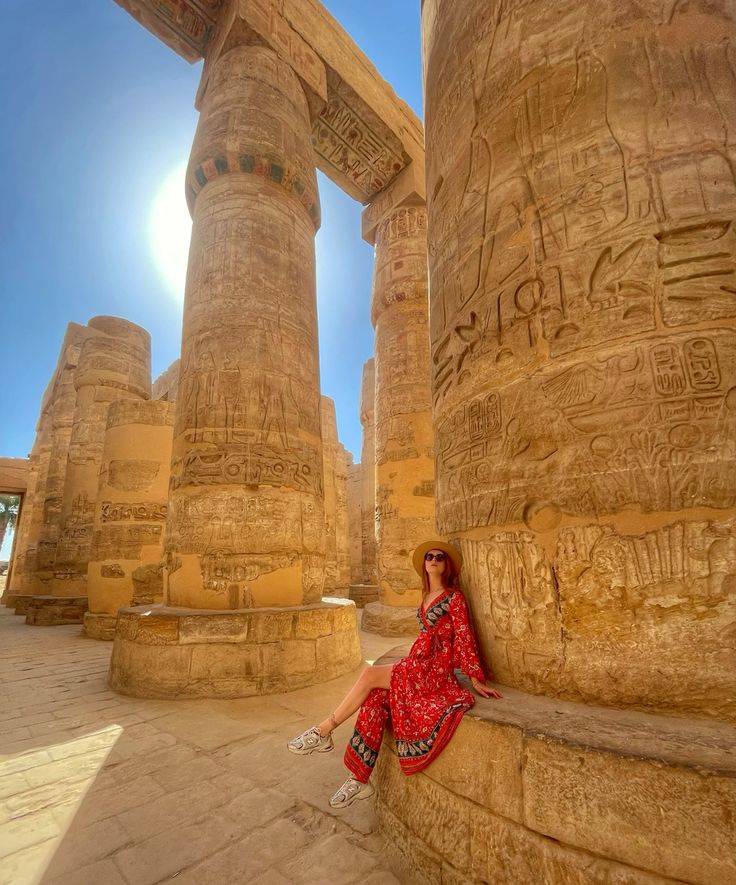
The Great Hypostyle Hall
The Great Hypostyle Hall is the most famous part of Karnak.
It is also one of the greatest achievements of ancient Egyptian architecture.
The hall was begun under Seti I and completed under his son, Ramesses II.
UNESCO records its dimensions as approximately 102 meters wide and 53 meters deep. Its roof was supported by 134 columns, with the largest central columns reaching about 20.4 meters in height.
These numbers are impressive.
But the experience of standing among the columns is even more powerful.
Why Are the Columns So Huge?
The columns supported a massive stone roof.
Their size was therefore partly structural.
However, they also had symbolic importance.
Ancient Egyptian architecture often connected columns with plants.
Some columns resemble papyrus or lotus forms.
This symbolism connected the temple with the natural world and the sacred landscape of Egypt.
The Nile Valley was surrounded by plants, water, fertile land, and desert.
The temple transformed these natural ideas into stone.
The Central Nave
When you enter the Great Hypostyle Hall, look toward the central area.
The central columns are taller than many of those around them.
This creates a raised central nave.
Stone roofing once covered the hall.
Higher sections allowed light to enter through clerestory openings.
This produced a dramatic combination of shadow and sunlight.
Today, much of the roof is gone.
However, the surviving columns still give visitors an idea of the original scale.
Look upward.
Then look along the rows.
The repeated columns create a powerful visual effect.
The Columns of Karnak
The columns are among the first things visitors notice.
They are not identical.
Some are decorated with different designs.
Others contain inscriptions and reliefs.
Many originally had bright colors.
Over thousands of years, much of the original paint disappeared.
However, traces of ancient color survive in various areas of the complex.
UNESCO’s documentation includes surviving colored hieroglyphs at Karnak, demonstrating that the temple’s decoration was not always the plain stone appearance visitors often see today.
This is an important point.
Ancient Egyptian temples were often colorful.
The image of Egypt’s monuments as bare sandstone structures is largely the result of time.
Reading the Reliefs
Karnak is filled with carved scenes.
At first, these reliefs may seem difficult to understand.
However, there are several things worth looking for.
You will often see the pharaoh standing before a god.
The king may offer:
- Food
- Flowers
- Incense
- Wine
- Sacred objects
- Symbols of kingship
Other scenes show military victories.
Some depict religious ceremonies.
Others show processions or offerings.
The images were not simply decoration.
They communicated ideas about the king, the gods, and the proper order of the universe.
How to Read a Pharaoh’s Relief
When you see a pharaoh carved on a wall, look at his position.
He is often shown larger than other human figures.
This reflects his special status.
The gods may also appear larger or more symbolically powerful.
Pay attention to the objects in the king’s hands.
They can provide clues about the ceremony being represented.
Also look for hieroglyphs.
The inscriptions can identify:
- The king
- The deity
- The offering
- The ceremony
- Royal titles
- Religious statements
You do not need to read ancient Egyptian to appreciate the scenes.
A knowledgeable guide can explain the most important symbols.
Hatshepsut and Karnak
Queen Hatshepsut was one of the most important rulers connected with Karnak.
She ruled during the Eighteenth Dynasty.
Hatshepsut was a major builder.
Her projects can be found at several sites across Egypt.
At Karnak, she contributed important structures and monuments.
One of the most famous is her red granite obelisk.
The obelisk is a powerful example of royal monumentality.
It also demonstrates how rulers used Karnak to express their authority and devotion to the gods.
Hatshepsut’s monuments were later affected by political changes.
Some of her images and names were deliberately altered or removed.
This adds another historical layer to the temple.
Karnak therefore records not only religious beliefs but also political struggles.
The Obelisks of Karnak
Obelisks are among the most striking structures in ancient Egyptian architecture.
They are tall, four-sided monuments with a pyramid-shaped top.
They were often associated with the sun.
Karnak contains several famous obelisk remains.
The most famous surviving example is the great obelisk associated with Hatshepsut.
It was carved from a single block of granite.
Its original height was enormous.
Standing beneath it helps visitors understand the ambition of ancient Egyptian royal architecture.
Why Did Pharaohs Build Obelisks?
Obelisks had religious and royal symbolism.
Their pointed tops were associated with sunlight.
They could also commemorate a ruler’s achievements and devotion to a deity.
An obelisk was therefore more than a monument.
It connected the king with the gods and with the eternal nature of the cosmos.
The polished surface would have reflected sunlight.
Imagine the monument when it was newly completed.
The granite would have been brighter and more polished than the weathered stone visible today.
Thutmose I and the Expansion of Karnak
Thutmose I was another important builder at Karnak.
During the early Eighteenth Dynasty, the temple complex expanded dramatically.
Thebes became increasingly important as a royal and religious center.
Thutmose I contributed to this development.
His building projects helped create the monumental landscape that later rulers continued to expand.
This is one reason Karnak should be viewed as a living historical record.
One pharaoh built something.
A later ruler added another structure.
Another king changed the decoration.
Centuries later, new buildings appeared.
The complex grew over generations.
Thutmose III and Karnak
Thutmose III was one of ancient Egypt’s most successful military rulers.
He also contributed significantly to Karnak.
His reign followed that of Hatshepsut.
He expanded and modified parts of the temple complex.
His monuments reflect the connection between royal power and divine support.
Karnak was therefore not separated from politics.
The temple was an important place where the king’s relationship with the gods was publicly represented.
Seti I and Ramesses II
The names Seti I and Ramesses II are especially important when discussing the Great Hypostyle Hall.
Seti I began the project.
Ramesses II completed it.
The hall is therefore a monument associated with two generations of royal power.
The reliefs and inscriptions provide a visual record of their reigns.
This is another example of how Karnak developed over time.
The monument was not simply the work of one architect or one pharaoh.
It was part of a much larger royal tradition.
Sacred Spaces Inside Karnak
As you move deeper into the complex, the spaces become more sacred and restricted.
The inner areas were connected with the presence of the deity.
A temple’s sanctuary was not simply another room.
It was the heart of the religious structure.
A sacred image of the god could be kept there.
Priests performed rituals.
The king was symbolically connected with these ceremonies.
Visitors today cannot experience the ancient rituals directly.
However, the architecture helps us understand the basic concept.
The temple moved from the large outer world toward a more private sacred center.
The Sacred Lake
Another important feature of Karnak is the Sacred Lake.
Water had great religious importance in ancient Egypt.
The Nile was the foundation of Egyptian civilization.
Water represented life, fertility, renewal, and purification.
Priests could use sacred water in rituals.
The lake therefore formed part of the religious environment of the temple.
Today, it also provides a useful place to pause during a visit.
After walking through the enormous halls and courtyards, the open water offers a completely different atmosphere.
The Temple of Khonsu
Karnak is not only about Amun-Ra.
The complex also contains structures dedicated to other deities.
One important example is the Temple of Khonsu.
Khonsu was associated with the moon.
He was also part of the Theban divine family with Amun and Mut.
This illustrates the broader religious system represented at Karnak.
The temple complex was not dedicated to one isolated god.
It was a sacred landscape involving several related divine traditions.
The Precinct of Mut
The goddess Mut was closely associated with Amun.
Her precinct lies south of the main Amun complex.
Mut was connected with motherhood, queenship, and divine power.
Her presence at Karnak demonstrates the interconnected nature of Theban religion.
The larger Karnak area should therefore be understood as a collection of related sacred spaces.
Karnak and Ancient Egyptian Festivals
Festivals were an important part of temple life.
One of the most famous Theban celebrations was the Opet Festival.
During the festival, the sacred forms of the gods were carried in procession.
The route connected Karnak with Luxor Temple.
The journey was not simply a religious parade.
It expressed renewal, kingship, divine power, and the relationship between the gods and the ruler.
The temple landscape was therefore designed for movement.
Its courtyards, gateways, columns, and avenues were part of a ceremonial experience.
Karnak and the Nile
The Nile was central to ancient Egyptian civilization.
Karnak’s location on the east bank of the river was meaningful.
The temple complex was part of a much larger Theban landscape.
Across the Nile lay the west bank, where many royal funerary monuments and tombs were located.
The contrast between the east and west banks is useful for visitors.
The east bank was strongly associated with temples and the living city.
The west bank became famous for royal tombs and funerary monuments.
Together, they formed one of the greatest archaeological landscapes in Egypt.
UNESCO recognizes Ancient Thebes, including its temples, tombs, palaces, and other monuments, as a World Heritage site of outstanding cultural importance.
Astronomical Orientation at Karnak
Karnak’s architecture also reflects an important relationship with the sky.
Research on Egyptian archaeoastronomy has examined the orientation of the temple.
UNESCO’s thematic study notes that the temple of Amun at Karnak was aligned with significant solar events and that later additions maintained important aspects of the original orientation.
This does not mean every part of Karnak was built as an astronomical instrument.
Rather, the orientation shows that the ancient Egyptians connected architecture, landscape, religion, and celestial events.
The temple was part of a cosmic world.
Why Is Karnak So Important?
Karnak is important for several reasons.
Religious importance
It was one of the most important centers of worship for Amun and Amun-Ra.
Historical importance
It records the work of numerous pharaohs over many centuries.
Architectural importance
Its pylons, columns, obelisks, courtyards, and halls demonstrate extraordinary engineering and artistic skill.
Artistic importance
Its reliefs and inscriptions provide information about Egyptian religion, kingship, warfare, and daily life.
Archaeological importance
The complex continues to provide evidence about the development of ancient Egyptian civilization.
What Should You Look For During Your Visit?
Karnak can feel overwhelming.
There is simply too much to see at once.
Instead of trying to examine everything, focus on several major features.
1. The Entrance
Start by appreciating the monumental scale.
Look at the pylon.
Notice how small modern visitors appear beside it.
2. The Great Court
Pause here.
Look at the statues and columns.
Imagine how the space might have looked during ancient ceremonies.
3. The Great Hypostyle Hall
Spend extra time here.
Look at the columns.
Then examine the reliefs.
Do not simply walk through.
Look upward and study the surviving architectural details.
4. Hatshepsut’s Obelisk
Look at its height.
Then think about how ancient craftsmen extracted, transported, shaped, and raised such a massive granite monument.
5. The Sacred Lake
Take a short break.
The lake helps you appreciate the religious environment of the temple.
6. The Hieroglyphs
Choose a few walls.
Ask your guide to explain the scenes.
You will understand much more when you know who the figures represent.
Practical Tips for Visiting Karnak From Hurghada
A Luxor excursion from Hurghada is one of the most popular ways to experience ancient Egyptian history during a Red Sea holiday.
However, the journey requires planning.
Start Early
The distance between Hurghada and Luxor means that an early start is usually a good idea.
It allows more time for sightseeing.
It also helps you avoid spending the hottest part of the day walking around the temple.
Wear Comfortable Shoes
Karnak is large.
You will walk considerable distances.
Choose comfortable shoes with good support.
Avoid wearing footwear that is difficult to walk in for several hours.
Bring Sun Protection
Luxor can be very sunny.
Bring:
- Sunglasses
- A hat
- Sunscreen
- Light clothing
- Drinking water
These simple items can make the visit much more comfortable.
Bring Water
Hydration is important.
Keep water with you and drink regularly.
This is particularly important during the hotter months.
Consider a Guide
Karnak is much easier to understand with a knowledgeable guide.
Without context, a wall full of hieroglyphs can simply look like a collection of symbols.
A guide can explain the pharaohs, gods, rituals, and historical events represented in the temple.
This can transform your visit.
Choosing a Luxor Tour From Hurghada
Travelers staying in Hurghada have several options for visiting Luxor.
You may choose a group excursion.
This can be a practical option for travelers who prefer a structured schedule.
Another option is a private tour.
Private travel can provide more flexibility.
You may have more control over sightseeing time, breaks, meals, and the pace of the day.
When considering Best Tours Hurghada, compare the full itinerary before booking.
Check whether the tour includes:
- Hotel pickup
- Transportation
- Professional guide
- Karnak Temple
- Valley of the Kings
- Hatshepsut Temple
- Colossi of Memnon
- Lunch
- Entrance tickets
- Return transportation
Not every Luxor excursion includes the same attractions.
Therefore, reading the itinerary carefully is important.
Karnak Temple and the Valley of the Kings
If you are visiting Luxor from Hurghada, try to understand the relationship between the east and west banks.
Karnak is on the east bank.
The Valley of the Kings is on the west bank.
The two areas served very different purposes.
Karnak was a major religious center.
The Valley of the Kings became a royal burial area.
Visiting both provides a much deeper understanding of ancient Thebes.
You see the temples of the gods on one side.
Then you see the tombs of kings on the other.
Together, they reveal how ancient Egyptians connected religion, kingship, death, and the afterlife.
Karnak Temple vs. Luxor Temple
Many travelers visit both temples.
They are close to each other and were connected through the ancient processional landscape.
However, they are not identical.
Karnak is larger and more complex.
Luxor Temple has a more compact architectural experience.
Karnak feels like an enormous religious city.
Luxor Temple feels more concentrated.
If your schedule allows, visiting both is highly recommended.
Together they provide a richer understanding of ancient Thebes.
Frequently Asked Questions About Karnak Temple
How old is Karnak Temple?
Karnak developed over many centuries.
Its history includes Middle Kingdom foundations and major expansions during the New Kingdom and later periods.
It is therefore better to think of Karnak as a continuously developing temple complex rather than a monument built at one particular date.
Who built Karnak Temple?
Many pharaohs contributed to Karnak.
Important builders include Senusret I, Hatshepsut, Thutmose I, Thutmose III, Seti I, and Ramesses II, among others.
Who built the Great Hypostyle Hall?
Seti I began the Great Hypostyle Hall.
Ramesses II completed it.
UNESCO identifies the hall as a major achievement of ancient Egyptian architecture and records its 134 columns.
What god was worshipped at Karnak?
The main religious focus was Amun, who became closely associated with Ra as Amun-Ra.
Other gods, including Mut and Khonsu, were also represented within the wider complex.
Why are there so many columns at Karnak?
The columns supported large architectural structures.
They also had symbolic and artistic functions.
Many were decorated with plant-inspired forms, hieroglyphs, and religious scenes.
What is the most famous part of Karnak?
The Great Hypostyle Hall is probably the most famous area.
Its enormous columns and richly decorated walls make it one of the highlights of any visit.
Can I visit Karnak from Hurghada in one day?
Yes.
Day trips from Hurghada to Luxor are a popular option.
Because the journey is long, an organized itinerary can make the day easier.
What should I wear to Karnak?
Choose comfortable, lightweight clothing and walking shoes.
A hat and sun protection are also useful.
Is Karnak suitable for children?
Yes.
Children who enjoy history, architecture, and adventure can find the huge columns and ancient monuments fascinating.
However, the amount of walking should be considered when planning the day.
Is Karnak worth visiting?
Absolutely.
Karnak is one of the most impressive ancient temple complexes in Egypt.
Its enormous scale, religious history, columns, obelisks, and reliefs make it a highlight of Luxor.
Final Thoughts: Why Karnak Should Be on Your Egypt Itinerary
Karnak Temple is not simply a collection of ancient ruins.
It is a record of Egyptian civilization carved into stone.
Every section tells a different story.
The pylons reveal royal ambition.
The columns demonstrate engineering and religious symbolism.
The obelisks celebrate the power of the pharaoh.
The reliefs preserve religious ceremonies and historical events.
The sacred spaces reveal the importance of the gods.
The Great Hypostyle Hall demonstrates the extraordinary scale of ancient Egyptian architecture.
Most importantly, Karnak helps visitors understand that ancient Egypt was not built in a single generation.
It developed over centuries.
Pharaoh after pharaoh added something new.
Some rulers honored their predecessors.
Others changed or erased their names.
New religious ideas appeared.
Political power shifted.
Yet Karnak continued to grow.
That is what makes the site so special.
When you walk through the Great Hypostyle Hall, you are not looking at one moment in Egyptian history.
You are looking at centuries of history layered together.
For travelers staying in Hurghada, a Luxor excursion offers the opportunity to experience this history firsthand.
The journey may be long, but the reward is enormous.
With good preparation and a well-organized itinerary from a provider such as Best Tours Hurghada, you can explore Karnak while also visiting other major Luxor attractions.
Take your time.
Look beyond the giant monuments.
Read the reliefs.
Study the hieroglyphs.
Notice the different styles of columns.
Look at the obelisks.
Think about the rituals that once filled these courtyards.
Then imagine Karnak as it may have appeared thousands of years ago, when priests, kings, musicians, and worshippers moved through a living sacred landscape.
That is the real magic of Karnak Temple.
It does not simply show you the past.
It helps you imagine it.